
4. Risk section
4.1 Solvency position
The solvency position of DELA Group is determined using the standard model in Solvency II.
The Solvency II ratio saw a slight increase in 2025 as a result of changes in interest rates, inflation and the coverage ratio. Stress tests show that the solvency position is robust, although DELA Group is sensitive to scenarios with low interest rates and low inflation.
4.1.1 Development of solvency capital requirement
The composition of the capital requirement is illustrated by the diagram below.
Composition of SCR
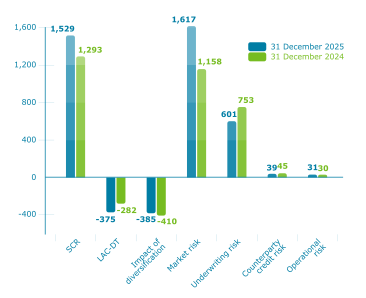
LAC-DT = Loss Absorbing Capacity of Deferred Taxes
The SCR saw an increase, which was primarily due to market risks. It is clear that the underwriting risks and market risks are the greatest risks. The market risks increased, compared with a decrease in the underwriting risks. This is explained in more detail in section 4.2.1.
4.1.2 Development of own funds
In 2025, the own funds (these are the own funds in the Solvency II balance sheet) increased on the back of a decrease in the value of the technical provisions. This was driven by the higher interest rates and because more expenses were allocated to the coverage ratio in line with Solvency II. The composition of own funds is illustrated by the diagram below (amounts in € million).
Composition of own funds
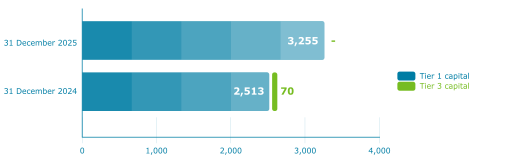
Similar to last year, the own funds consists almost entirely of tier 1 capital. All basic tier 1 items are fully at DELA's disposal.
4.2 Risk profile
DELA is exposed to strategic risks, market risks, underwriting risks, operational risks, integrity risks, and reputation risks. The 'Our governance' section of the report of the Executive Board sets out the main risk areas. It also describes the developments in 2025 regarding the main risks.
The various risks are explained in more detail in the sections below. For improved readability, not all risks are described in detail, and some are combined.
Sustainability-related risks materialise in the event of market risks in particular and are part of the risk categories discussed in the following sections. See the sustainability section of the report of the Executive Board for a detailed explanation of sustainability-related risks.
4.2.1 Financial risks
Financial risks include market risks, underwriting risks, credit risk and liquidity risk.
4.2.1.1 Market risks
The market risk is the risk of possible losses due to adverse developments in the financial markets. The value of the investments and the value of the liabilities depend on developments in these markets, the composition of the investment portfolio and the characteristics of the insurance liabilities.
DELA Group has mitigated the market risk to a significant extent through its profit sharing scheme and premium action, as well as via derivatives that mitigate part of the currency risk. DELA Group applies the 'prudent person' principle to its investment policy, and full and/or partial ALM studies are regularly performed to assess whether the investment policy is still suitable.
The table below shows the development of the market risk, quantified using the standard model shown (amounts in € million).
Market risk development
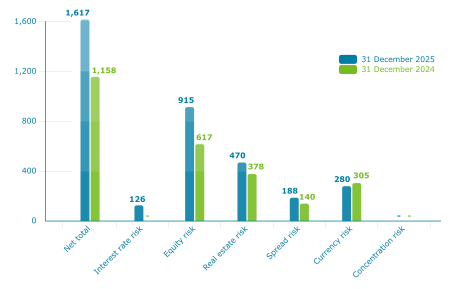
The share risk increased because of the higher percentage that must be maintained for this risk (symmetric adjustment). Because of the lower value of the profit sharing option, profit sharing had less of a mitigating effect, prompting a slight increase in all market risks, including the interest rate risk. On the other hand, the currency risk decreased because of the increased cover on the currency risk for the US dollar.
Market risks are driven in part by climate change. Climate scenario analyses show that the risks associated with climate change can result in a slightly higher increase in premiums. Solvency remains stable across the various climate scenarios.
No market risk limits were exceeded in 2025.
4.2.1.2 Underwriting risks
The underwriting risk is the risk that the size and timing of claims and/or expenses are not consistent with expectations. DELA Group mitigates the underwriting risk in various ways, such as its profit sharing scheme and premium action, but also via reinsurance, acceptance (medical), and a continuous focus on costs.
DELA Group is exposed to the life insurance risk only as it only provides life insurance. DELA Group's portfolio largely consists of funeral insurance, with separate rates for the Netherlands, Belgium, and Germany. These rates are based on specific characteristics and assumptions (actuarial interest, costs, life expectancy tables) aligned to each country. An annual review is conducted to assess whether these assumptions align with the development of the relevant portfolios. The portfolio is large in numbers and size, which reduces fluctuations in the results.
In addition, DELA Group markets a term life insurance policy in the Netherlands and Germany. The sums insured in that policy are significantly higher than in the funeral insurance. Reinsurance is used to limit any volatility of the results for this portfolio.
Finally, DELA Group has a savings-linked product in the Netherlands. The mortality risk in this portfolio is limited at 10 per cent of the accumulated value.
The diagram below illustrates the composition of the underwriting risk (amounts in € million).
Composition of underwriting risk
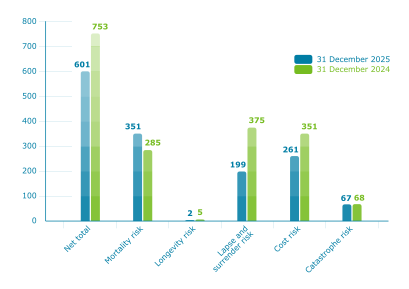
The underwriting risks decreased on balance, with various developments providing a changing picture of the underlying risks.
All underwriting risks increased as the mitigating effect of profit sharing decreased due to the lower option value of the profit share. This was compensated for in whole or part by the decrease in the technical provisions due to the higher interest rates, which means the exposure for underwriting risks was also lower. The composition of the technical provision changed due to the higher interest rates, leading to a decrease in the risk of lapses and surrenders. The cost risk decreased as well because more expenses were allocated to the coverage ratio, which means that profit sharing had more of a mitigating effect on the cost risk.
The standard model does not include the funeral cost inflation risk. Although this risk is borne by policyholders, it remains significant as an increase in funeral costs leads directly to higher premiums. DELA Group aims to provide excellent services to its members for the lowest possible premium, and this is a special focus in the own risk and solvency assessment (ORSA). DELA Group has some influence over the development of the rising cost of funerals due to inflation and closely monitors this trend throughout the year.
No underwriting risk limits were exceeded in 2025.
4.2.1.3 Credit risk
Credit risk (or: counterparty credit risk) is the risk of losses due to an unexpected default or unexpected worsening of the credit rating of the counterparties. This mainly involves amounts receivable related to mortgages, reinsurers, derivatives, and other debtors. In 2025, the size of the credit risk decreased to €35 million. Credit risk is not a material risk for DELA Group.
No credit risk limits were exceeded in 2025.
4.2.1.4 Liquidity risk
This is the risk that DELA Group is unable to fulfil its financial obligations to its policyholders or other creditors at any time because assets cannot be traded quickly enough. The liquidity risk is not expressed as a solvency capital requirement (SCR) in Solvency II. DELA Group must have sufficient cash and cash equivalents to pay claims arising from the existing insurance contracts and to pay for its other annual expenses. DELA Group can avail itself of credit facilities from the custodian of the shares and bonds or sell part of the liquid investments. DELA fulfilled its financial obligations to policyholders and other creditors in 2025.
No liquidity risk limits were exceeded in 2025.
4.2.2 Operational risks
In addition to financial risks, DELA Group also faces operational risks. These are risks resulting from external influences related to human error and the failure of processes and systems. The capital to be maintained for operational risks is limited compared to financial risks; it saw a slight increase in 2025.
Operational risk limits were exceeded in 2025 in the area of outsourcing. As a result, the responsible management initiated suitable action to return the risks to the desired level as quickly as possible. In addition, several activities for the implementation of DORA will continue in 2026.
Operational risks arise at all levels of the organisation. The main operational risk areas are explained in more detail below.
4.2.2.1 Internal and external fraud
DELA Group distinguishes between internal and external fraud risks. Internal fraud is that committed by DELA Group employees who undertake unauthorised activities to enrich themselves and by doing so harm DELA Group. Examples are embezzlement, unjustified expense claims, deliberately incorrect time reports, etc. External fraud is committed by someone from outside of DELA Group (third parties, suppliers, customers, etc.) whose unauthorised activities impact DELA Group. A second line compliance manager is responsible for the anti-fraud policy and for boosting awareness. The internal controls for fraud risks are tested on a quarterly basis.
4.2.2.2 Working conditions and safety
The risks included here involve losses due to acts that are inconsistent with the laws on working conditions, health or safety, or as a result of events related to inequality or discrimination.
4.2.2.3 System failure and process management
This concerns risks of disruptions to business activities due to system failure, including cyber risks and information security. The risk of losses due to the failure of transaction processing or process management or relationships with suppliers is also included.
4.2.2.4 Financial reporting
This includes reporting on risks and uncertainties with an impact on the reliability of the internal and external financial reporting. Among other things, this concerns uncertainties and the degree of subjectivity in complex valuations and risks of the failure of financial models and/or financial accounting systems. Internal controls are in place for these risks and are tested on a quarterly basis.
4.2.3 Integrity risks
Integrity risks go hand in hand with the threat to the reputation of, or the current or future threat to the capital or the profitability of a company due to insufficient compliance with the rules that are in force under or pursuant to any laws. In principle, DELA Group monitors this issue from its compliance function based on the topics in the systematic integrity risk analysis (SIRA). No capital is maintained for this risk.
The SIRA topics are as follows:
- Organisational and employee integrity: organisational integrity includes topics such as governance and outsourcing. Employee integrity concerns the integrity of the management, the internal supervisory body, and internal and external employees. Related subjects are pre-employment screening, skills, and conflicts of interest.
- Customer chain integrity: this concerns both the integrity of customers and how the organisation treats customers. It includes the integrity of the chain in which the company operates. Topics range from duty of care to combatting money laundering and terrorism financing.
- Market integrity: this concerns the integrity of the financial and other markets, including issues such as competition and market abuse.
- Integrity related to the processing of personal data: this involves the integrity of the data used within DELA Group (such as the processing and security of personal data).
- Tax integrity: this concerns the subtopics of tax governance and transfer pricing, VAT, payroll tax and corporation tax.
Integrity risk limits were exceeded twice in 2025. These were in the area of customer chain integrity and employee integrity. The responsible management initiated suitable action to return the risks to the desired level as quickly as possible.
4.2.4 Strategic risks
This involves uncertainties that may impede implementation of the long-term strategy. These risks may hinder expansion abroad or restrict the ability to keep to the business model with a profit sharing goal. These risks can largely be minimised via a proper strategy process, guided by external consultants and monitored by the Supervisory Board. Implementation involves business cases to assess the required investments and keep them manageable. In addition, the ORSA is used to analyse which risks are a potential threat to the continuity of DELA Group. Stress tests show that the solvency position is robust, although DELA Group is sensitive to scenarios with low interest rates and low inflation. Preparatory measures are taken or different choices made where necessary. The main preconditions and actions are set out in the capital policy, which is evaluated annually. No capital is maintained for strategic risks.
External trends that may impact the strategy are constantly monitored and included in the ongoing strategy process.
No strategic risk limits were exceeded in 2025.
4.2.5 Reputation risk
The reputation risk is the threat of any damage caused by a loss of reputation. Reputation loss may occur as a result of incidents related to the risk categories as described in the risk profile and is controlled by the active development of reputation management, with incident management being a major spearhead. This involves the timely identification of possible reputation risks and any associated spill-over effects, and taking timely management actions where necessary. The company culture and desired tone at the top are other important factors in mitigating this risk. They are supported by training programmes, the administrative organisation, and internal control.
No capital is maintained for reputation risk.
No incidents occurred in 2025 that significantly harmed our reputation.